

Visibility Is Now My Bottleneck
A recap of the year so far: the MS program, SignifyMD, building my own AI system, and my final semester.
October 2026 • ~5 min read
M.S. in Marketing Candidate | Marketing Strategy & Applied AI
I am a first-generation graduate student pursuing a Master of Science in Marketing at the University of Arizona. My background spans marketing support, operations, and client-facing roles, with a focus on clarity, execution, and data-driven storytelling.
See the "Building this Site..." blog post for the story of this interactive portfolio. Also, while the site is viewable on mobile devices, the site is optimized for a desktop view!
International marketing strategy project. Developed a phased market entry plan for Native deodorant entering Japan's $32B beauty market, navigating regulatory barriers and cultural repositioning.
A self-perception versus peer-perception study examining leadership communication, working style, and professional presence. Combines survey analysis, reflection, and applied business communication theory.
Agentic RAG system for pharmaceutical drug safety signal triage. Multi-agent architecture combining LangChain, ChromaDB, and Cohere Rerank to automate pharmacovigilance analyst workflows.
A recap of the year so far: the MS program, SignifyMD, building my own AI system, and my final semester.
October 2026 • ~5 min readRead my first post on why I built this site and what I hope it becomes.
1/4/2026 • 1 min readA snapshot of the tools, research methods, and analytical skills I'm beginning to develop as I start my master's coursework at the University of Arizona.
1/14/2026 · 3 min readJapan's beauty market is worth $32 billion, yet deodorant penetration sits at only 55% which is far below the global average of 92%. This gap exists because of cultural factors: minimal odor expectations due to daily bathing habits and genetic factors (ABCC11 gene variation means less body odor for East Asian populations). But this also means tremendous upside for the right brand entering at the right time. Native, as a premium natural deodorant aligned with wellness trends, has a real opportunity to capture share in Japan's growing consciousness around freshness and personal care.
Japan classifies deodorants containing antiperspirant actives as quasi-drugs, requiring 12–18 months of Ministry of Health, Labour and Welfare (MHLW) approval. Instead of treating this as a blocker, the strategy uses it as a sequencing tool: Phase 1 launches Native as a cosmetic-classified body fragrance/deodorant through e-commerce (Amazon Japan, Rakuten) to build brand awareness and consumer reviews. Phase 2 runs the regulatory approval process in parallel while gathering market data. Phase 3, upon approval, transitions to full deodorant launch in retail channels with Japan-exclusive formulations.
The biggest insight: don't sell deodorant in Japan. Sell "kirei"-the concept of freshness, cleanliness, and wholeness. Position Native as a wellness product aligned with Japanese beauty standards around minimal scent, natural ingredients, and purity. The marketing, scent profiles, and retail placement all emphasize wellness category positioning, not functional odor control (which carries cultural stigma). This required repositioning the entire brand narrative for the market.
This case demonstrates sophisticated strategic thinking: how to navigate regulatory constraints as sequencing opportunities, how cultural understanding reshapes positioning, and how phased rollout enables data-driven decisions at each stage. It shows the ability to synthesize market research, regulatory environment, competitive positioning, and cultural adaptation into a coherent go-to-market strategy. This is the kind of multi-variable decision-making that matters in real marketing leadership roles.
Insight into how I perceive myself as a professional compared to how others experience my working style
During the first semester of my junior year in my Business Communication course, we built professional portfolios and worked to clarify who we were as emerging professionals and who we wanted to become. As part of that process, I created an anonymous perception survey and asked people who had worked with me in real professional settings to describe my working style. My sample included two managers, two colleagues at my level, and one former team member. While I would have preferred a larger sample, the responses were thoughtful and consistent, providing a meaningful signal rather than random data about how my working style is perceived compared to how I see myself.
To get a better sense who I am, I took a self perception survey which took a look at many facets of my persona in a professional setting.
In analyzing my Culture Map results and self-description, I perceive myself as an adaptable leader who values clear communication, blends theory with practice in persuasion, and balances collaboration with hierarchy. I prioritize trust-building through task completion and personal connections, handle disagreements with professionalism, and approach scheduling with a balance of structure and flexibility.
Overall, I see myself as growth-oriented, driven, hard-working, and a perfectionistic problem-solver, equipped to lead confidently in diverse environments.
To cross reference with my own perceptions (red circle), survey responses from five colleagues, including managers and peers, were collected to assess perceptions of my work style and personality (Image A).
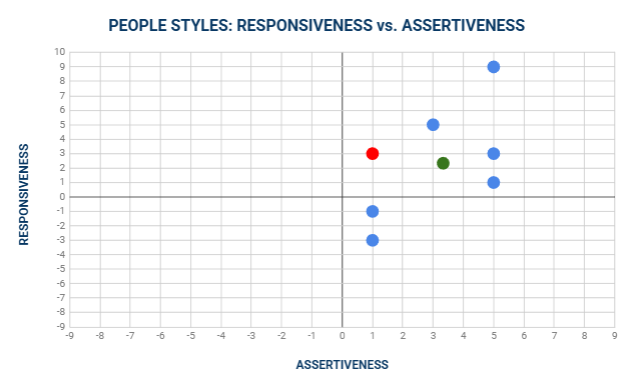
Image A - People Styles: Responsiveness vs Assertiveness
While I see myself as amiable, colleagues perceive me as more assertive and driven. These differences in perception emphasize the significance of understanding how others view my behavior. Addressing these discrepancies is vital for fostering effective communication and building stronger working relationships.
While I see myself as amiable, colleagues perceive me as more assertive and driven (green circle is group avg). These differences in perception emphasize the significance of understanding how others view my behavior. Addressing these discrepancies is vital for fostering effective communication and building stronger working relationships.
Acknowledging the disparity between self-perception and professional perception is vital for refining my business approach and client interactions. While I may see myself as amiable, colleagues perceive me as assertive and driven. This difference highlights the importance of understanding how others perceive my demeanor.
Neglecting to align my self-perception with others' perceptions could disrupt team dynamics and impede professional success. Misalignments in perceived assertiveness and drive may lead to confusion and conflict within a team, undermining trust and productivity. Failing to reconcile these differences can hinder performance and morale. Thus, it's essential to address these discrepancies to maintain a cohesive and successful working environment.
This project reflects where I was at the time, my junior year of undergraduate study, when I was actively forming my professional identity and exploring entrepreneurship. Looking back, it is interesting to reflect on the mindset I had then compared to where I am now.
Since creating this report, I have continued to develop both personally and professionally. I am now focused on creating impact at a broader scale, thinking more deeply about influence, positioning, and how ideas are communicated. The skills I began developing here such as self-awareness, audience perception, and intentional communication, have since evolved into a stronger interest in storytelling and, ultimately, marketing.
While this work represents an earlier stage of my journey, it laid important groundwork. The reflection, feedback, and self-assessment captured here have contributed to my growth into a more thoughtful, strategic, and impact-oriented business professional.
First-semester master's AI systems project automating pharmacovigilance workflows with multi-agent RAG.
Built for BNAN/MKTG 570, this project applies Retrieval-Augmented Generation and multi-agent orchestration to pharmacovigilance (the post-marketing drug safety function). The system automates routine analyst tasks like literature retrieval, FAERS trend analysis, and draft summary generation, while preserving human judgment for clinical signal validation.
Project Proposal & Data Strategy
Defined the pharmacovigilance signal triage workflow, outlined data sources, and scoped the four agent roles.
Core RAG Pipeline Construction
Implemented document loading, chunking, embedding, and ChromaDB storage. Built Gradio interface and tuned retrieval hyperparameters.
Agentic Orchestration & Refinement
Implemented multi-agent workflow with meta-intelligent routing, four specialized strategies, and enhanced retrieval layer with Cohere reranking.
Final Presentation & System Delivery
Live demonstration delivered, fully commented notebook published, and critical analysis of performance, governance, and production deployment requirements completed.
The system coordinates four specialized agents, each scoped to a distinct step of the pharmacovigilance workflow:
The system's routing intelligence is validated through measurable performance tradeoffs documented during development. Simple PRR lookups resolve in 2–3 seconds via the Naive chain; comprehensive multi-agent analyses take 8–12 seconds with four parallel LLM calls, a deliberate tradeoff and not an oversight. The on-topic relevance guardrail, running on every query via gpt-4o-mini, achieves over 95% classification accuracy at roughly 1/20th the cost of gpt-4o, demonstrating that right-sizing AI to task complexity is itself a performance strategy.
The system processes queries against 17,313 FAERS rows across five document types, with parent-child chunking (2,000/400 chars) ensuring both precise semantic retrieval and rich contextual generation in the final response.
PharmaSignal RAG automates the initial triage phase (literature retrieval, FAERS trend analysis, and draft summary generation) while deliberately preserving human judgment for clinical signal validation. The system's guardrails encode this boundary directly: queries asking for medical advice or clinical decisions are blocked, not answered. This is intentional architecture, not a limitation. In regulated environments like pharmacovigilance, understanding where AI should stop is as important as knowing where it can help. The system is designed to accelerate analyst workflows, not replace analyst judgment.
System architecture: a 9-layer pipeline from query intake to response delivery:
The most instructive limitation is the absence of conversation memory: each query is stateless. In a real analyst workflow, follow-up questions like "what about the ROR for that drug?" are essential, but the current architecture requires users to restate context every call. A production version would implement context windowing (last 5–10 exchanges) and a dynamic knowledge base refresh pipeline for quarterly FAERS updates. The architecture is right; operational completeness is the next iteration.